
Storage tanks are critical assets in refineries, chemical plants and large industrial facilities. Over time, factors like foundation settlement, internal pressure cycles, thermal expansion and corrosion can cause deformation that compromises structural integrity and operational capacity. Regular assessments are required under API 653 standards to identify settlement and verticality deviations before they result in catastrophic failure.
For one major chemical facility, OmniVueNDT was engaged to perform a comprehensive settlement and verticality investigation of a large storage tank. Traditional measurement methods can be time-consuming, require extensive scaffolding or present safety risks. Instead, OmniVueNDT deployed terrestrial 3D laser scanning to capture millions of precise data points across the entire tank structure.
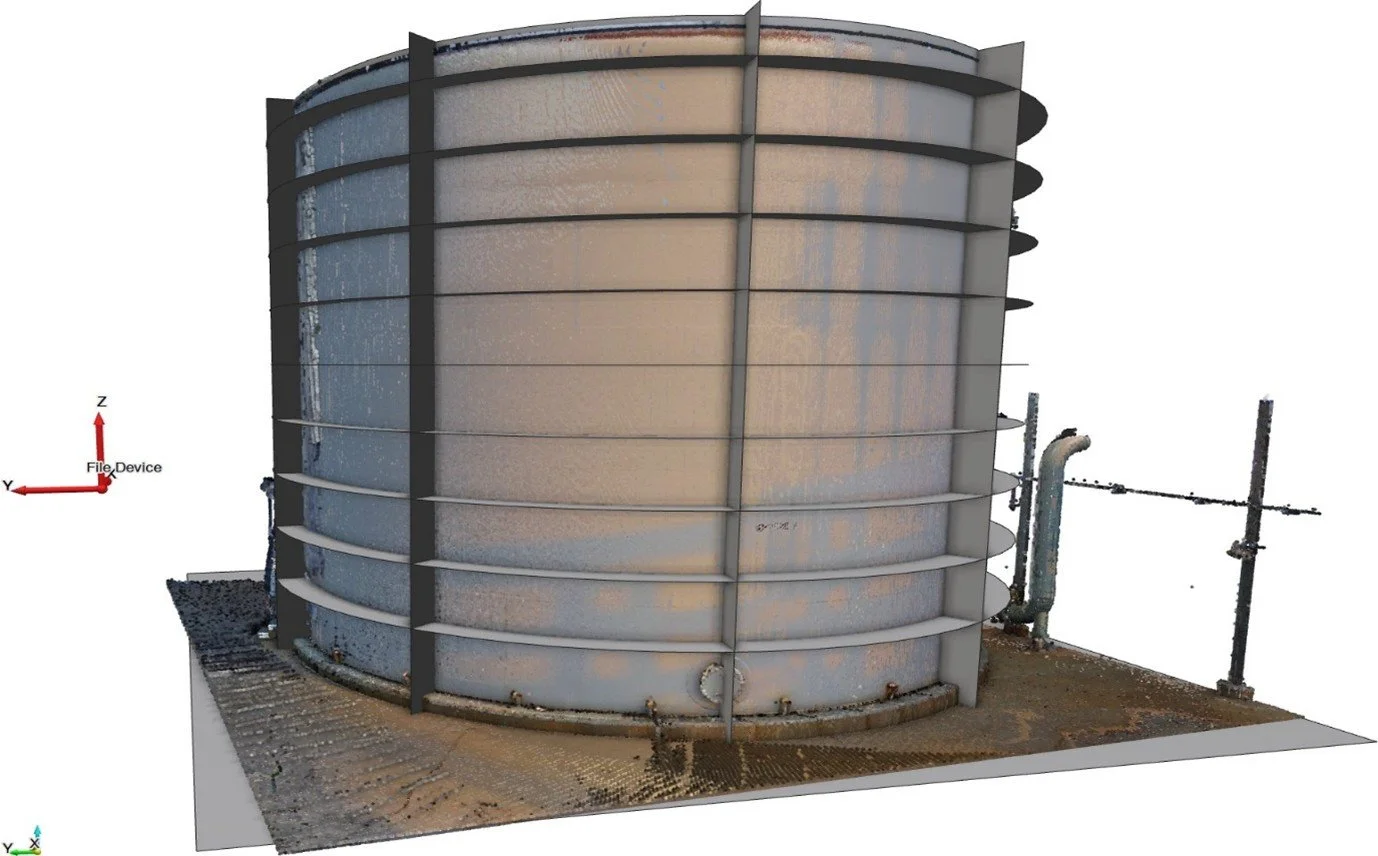
The image below shows the storage tank that was assessed during this investigation. OmniVueNDT's terrestrial laser scanning equipment captured the tank's complete geometry while it remained in service, eliminating the need for scaffolding or operational shutdown.
The Challenge: Detecting Deformation Before Failure
Storage tanks face continuous stress from operational demands. Foundation settlement, uneven loading and material degradation can lead to shell deformation that affects capacity, creates stress concentrations and increases the risk of catastrophic failure. API 653 Annex B requires periodic assessment of tank verticality and settlement to ensure safe operation.
Without accurate deformation data, facility operators risk:
Undetected structural weakness leading to tank failure
Regulatory non-compliance and failed inspections
Operational inefficiency from reduced capacity or flow restrictions
Costly emergency repairs and unplanned downtime
The client needed a detailed, non-intrusive assessment that could identify and quantify any deformation while the tank remained in service.
The Process: From Point Cloud to Precision Analysis
Using high-resolution terrestrial 3D laser scanners, OmniVueNDT's technicians captured the tank's geometry in its current operational state. The resulting point cloud data was processed into a detailed 3D model that accurately represented the tank's true shape, including any deformations or irregularities.
The model was then analyzed against a reference cylindrical profile to quantify:
Foundation settlement across the tank base
Vertical shell deformation and out-of-plumbness
Horizontal ring deformation indicating bulging or inward collapse
Quantitative deviation measurements at key elevation points
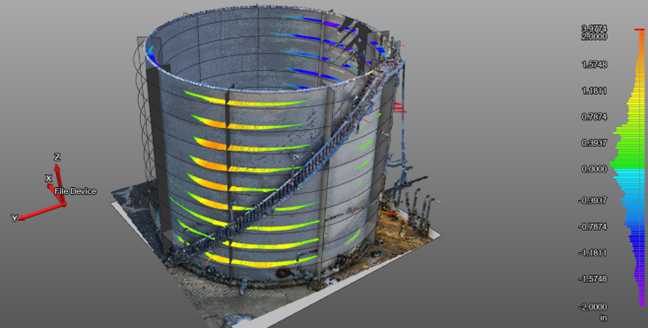
The images below show the results of the 3D laser scanning analysis. The first image presents the 3D model created from the point cloud data, showing the tank's actual geometry. The second image displays a qualitative deformation visualization, where color variations indicate areas of inward or outward shell deformation relative to the ideal cylindrical reference shape.
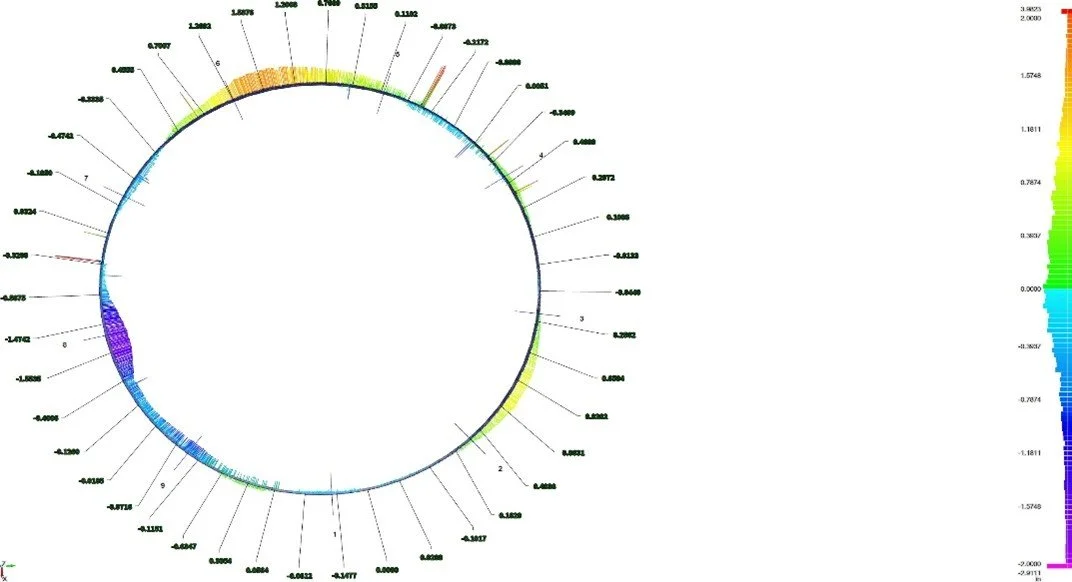
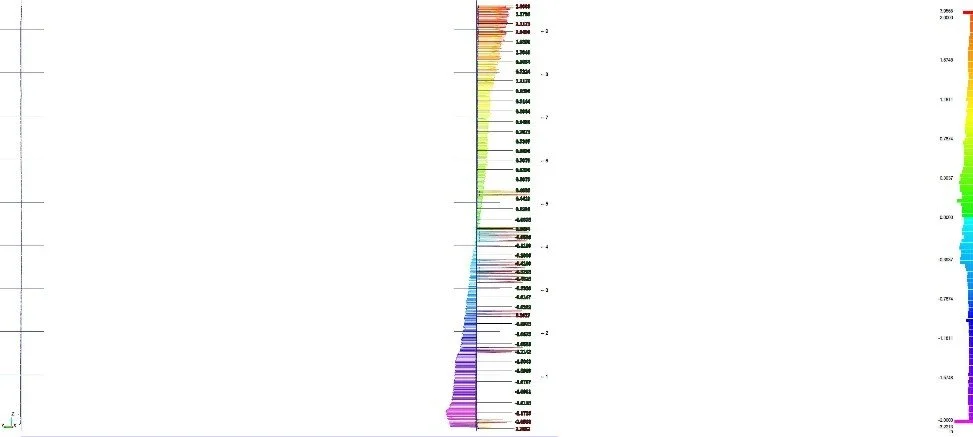
The cross-section analysis below shows vertical shell deformation determined from the reference cylindrical model. This view illustrates how the tank shell deviates from true verticality at different elevations, with measurements provided to quantify the degree of out-of-plumbness.
Deliverables That Drive Decision Making
The client received comprehensive documentation including:
High-resolution 3D models showing current tank geometry
Vertical and horizontal deformation cross sections
Color-coded deformation maps identifying critical areas
Quantitative deviation tables for engineering review
API 653 compliant assessment reports
The shell deformation map below presents both a visual representation and quantitative data for the tank assessment. The image shows a color-coded view of the tank shell with a numerical table providing specific deviation measurements at grid intersections. This comprehensive map indicates whether deformation is inward or outward at each measured point, giving engineers precise data for structural evaluation and repair planning.
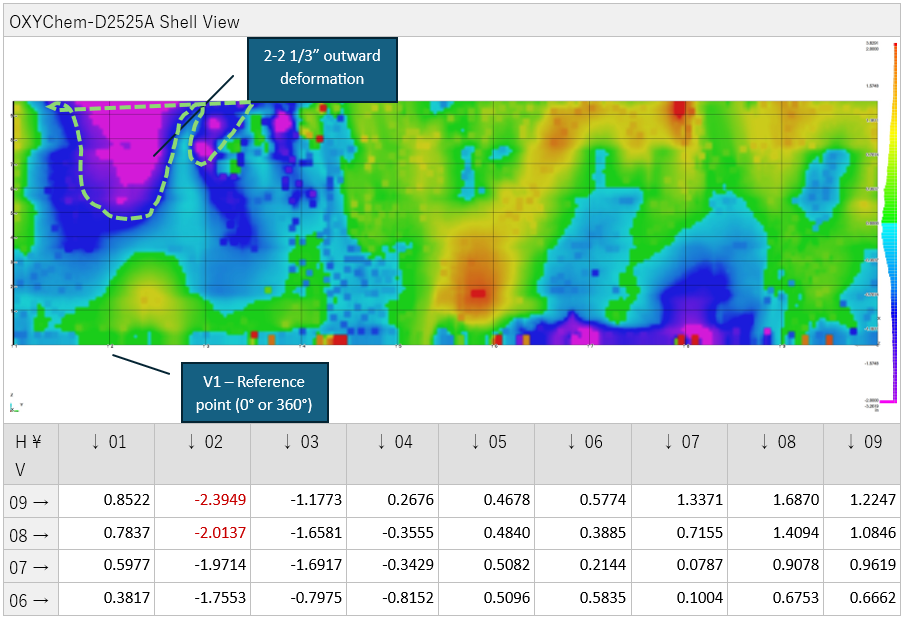
This data enabled the facility's engineering team to make informed decisions about repair priorities, operational adjustments and long-term maintenance planning — all without taking the tank out of service or deploying crews into potentially hazardous confined spaces.
Why This Matters: Proactive Asset Management
Without detailed deformation assessment, facilities operate with uncertainty about their storage tank integrity. The consequences can be severe:
Structural failures and safety incidents from undetected deformation
Regulatory violations and inspection failures
Loss of storage capacity affecting production schedules
Emergency shutdowns and expensive repairs
OmniVueNDT's 3D laser scanning delivers the precision and detail that traditional methods cannot match, giving engineering teams the exact information they need to maintain asset integrity and plan preventive maintenance with confidence.
Ensure Tank Integrity With Precision Assessment
If your facility operates storage tanks that require API 653 assessment or you need detailed deformation analysis for maintenance planning, OmniVueNDT's 3D laser scanning technology delivers the accuracy and detail you need. Contact us today to schedule a comprehensive tank assessment.